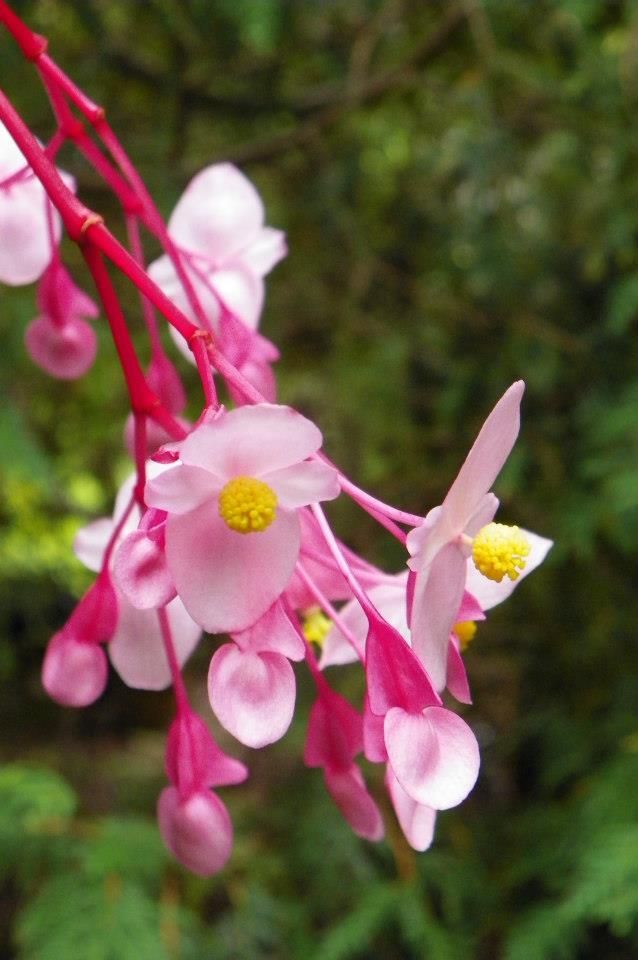
Begonia grandis is one of our favorite plants. It is , in some ways, similar to other tuberous begonias, but has some distinctions. the tubers are very dense and never get quite as large as regular begonias. They need to be planted significantly deeper than typical begonias and are also much hardier. In a zone 6b-7 climate, they could likely be left in the ground over the winter. Even here we have had little volunteers come up , either from tubers left in the ground or bulbils that have "seeded" off. In our area they are best stored indoors overwinter in a dark, cool dry area.They get "potted up" about mid-April each year for the next years growth.
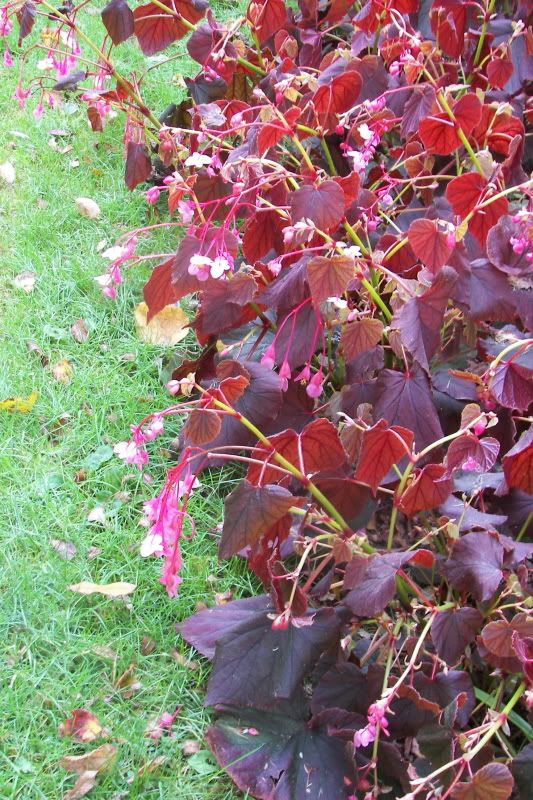
They are beautiful foliage plants that prosper both in planters or in ground. It would seem I don't have a nice image of the lovely deep red underside of the leaves. They are much sturdier than regular tuberous begonias, so withstand the rigors of weather a bit better.
They bloom late in the season and continue to be beautiful until a hard frost. we often dig them before that hard frost has happened.
Our supply of B. grandis started off with only one or two little tubers that Bill got from Cruikshanks back in the day. There has been quite a bit of multiplication, so we now have many.
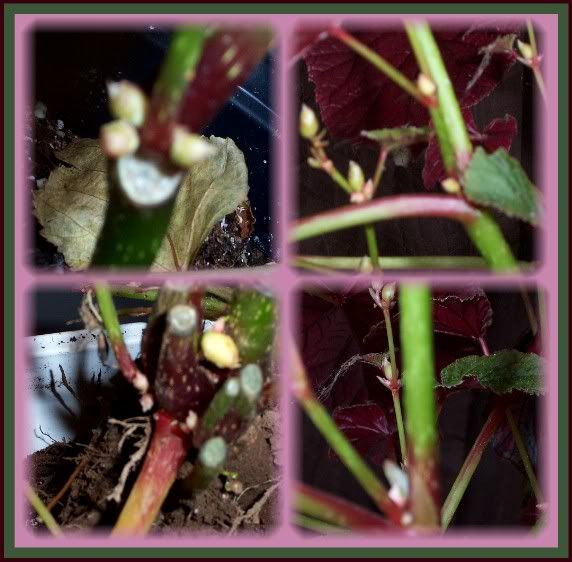
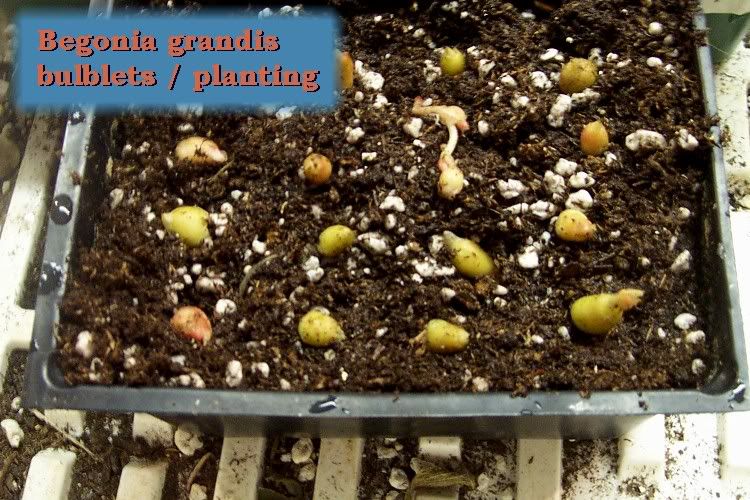
About 2004, we discovered a very large number of little bulbils on the plants leaf axils when we were harvesting the tubers in late fall. We decided to see if they could be grown.
The little bulbils were "sown" in medium and kept just slightly damp for a few weeks. Expecting they would typically get a cold period, we packed the packs in plastic and put them in the fridge for the winter.
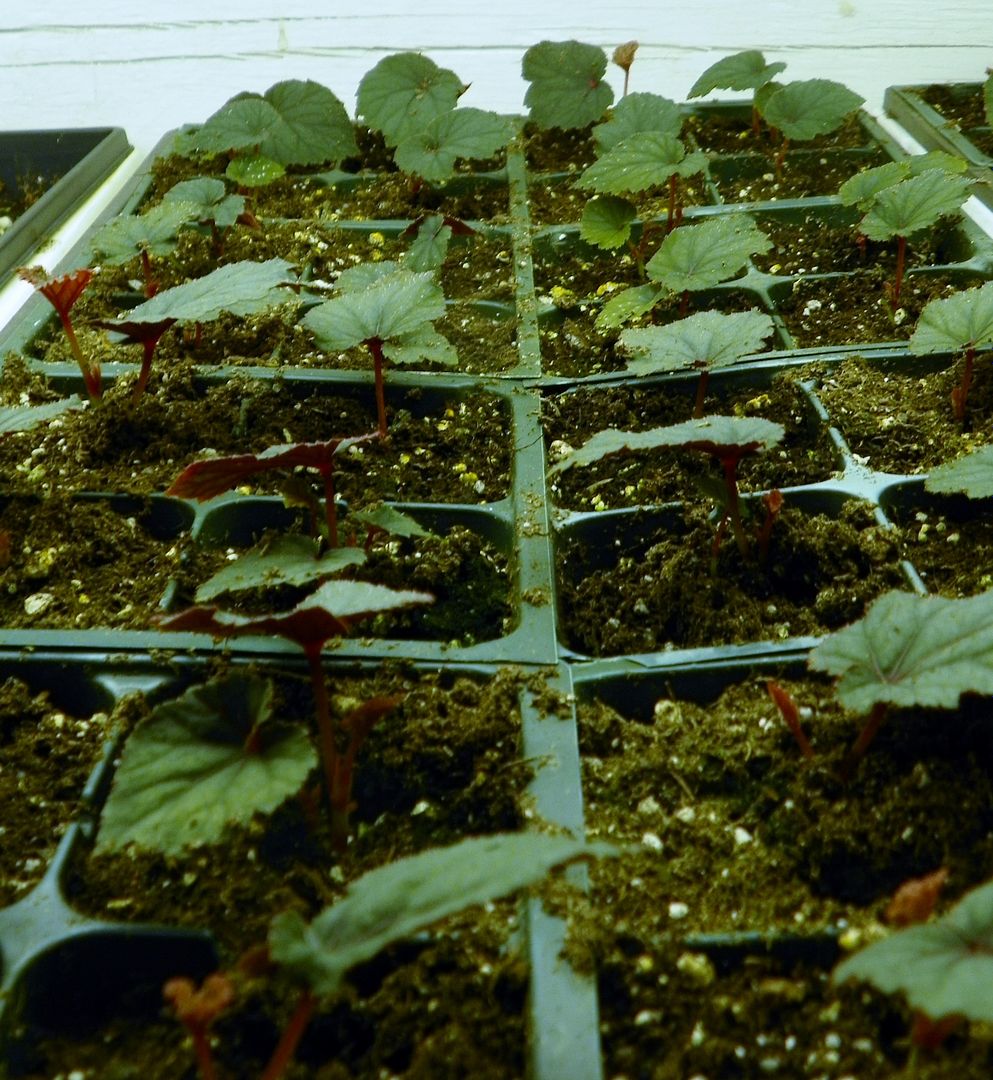
The packs were brought out in early spring, put under lights and in a short time little sprouts appeared. These grew into small tuberous plants which made significant growth by the end of that summer.
They were harvested and stored the same as the bigger tubers and the next year, were blooming size.
Last fall (2012) there were an inordinate number of bulbils formed, so I thought I would save some and list them in the ARHS Seed Exchange. The many bulbils were put in three packs of mix and treated as before. Some were shipped off packed in a bit of medium for orders received. Many were left and the packs were taken from the fridge March 14th. Growth started to appear about two weeks later.
They have grown very fast and were transplanted to 4-cell packs April 8th.
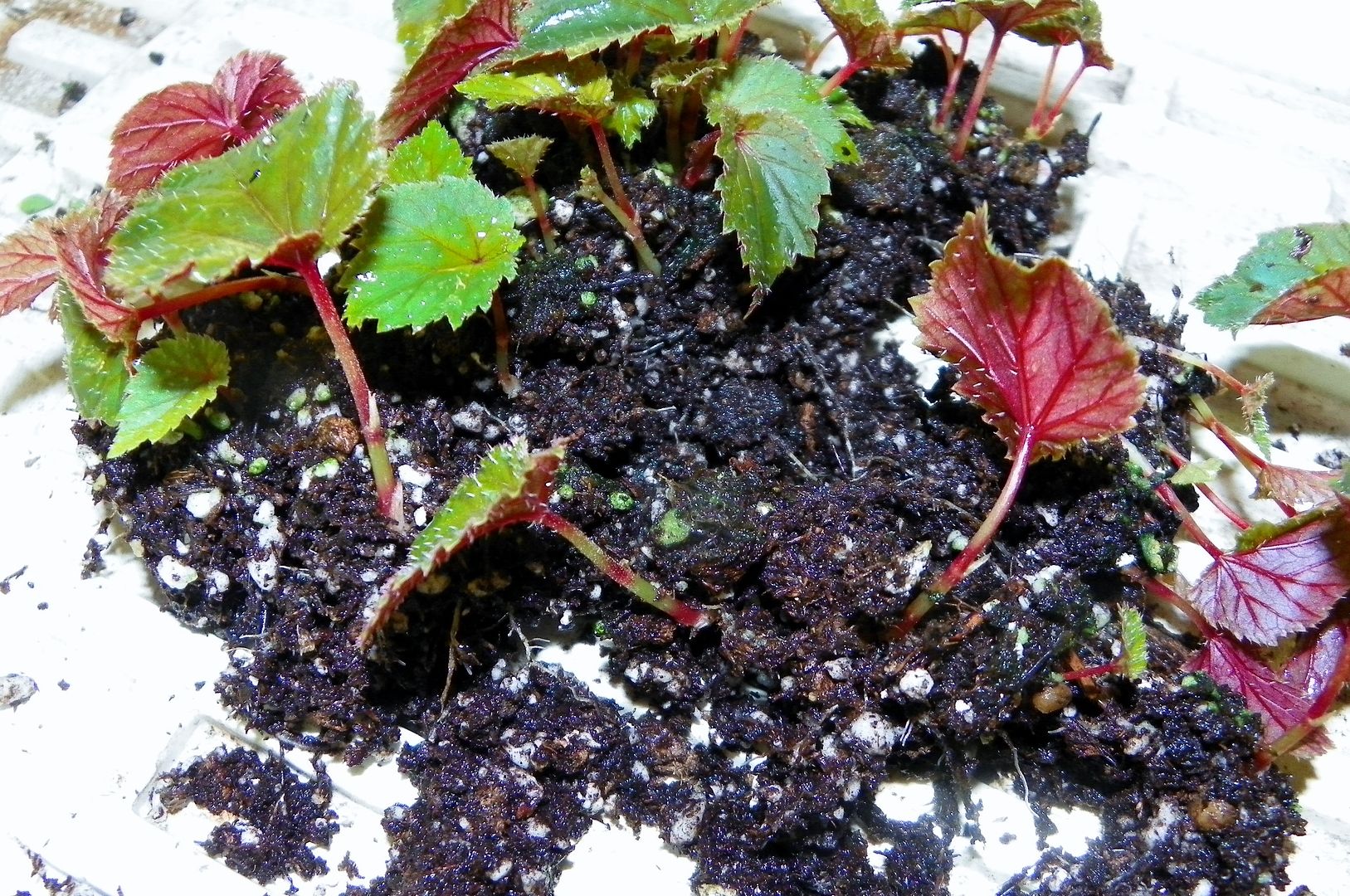
This is the storage pack popped out to show the roots profile before separating them into individual little plants.
They were very easy to handle and came apart with very little apparent disturbance.
It would appear there are sixteen packs plus a couple of small packs with some tiny remnants.
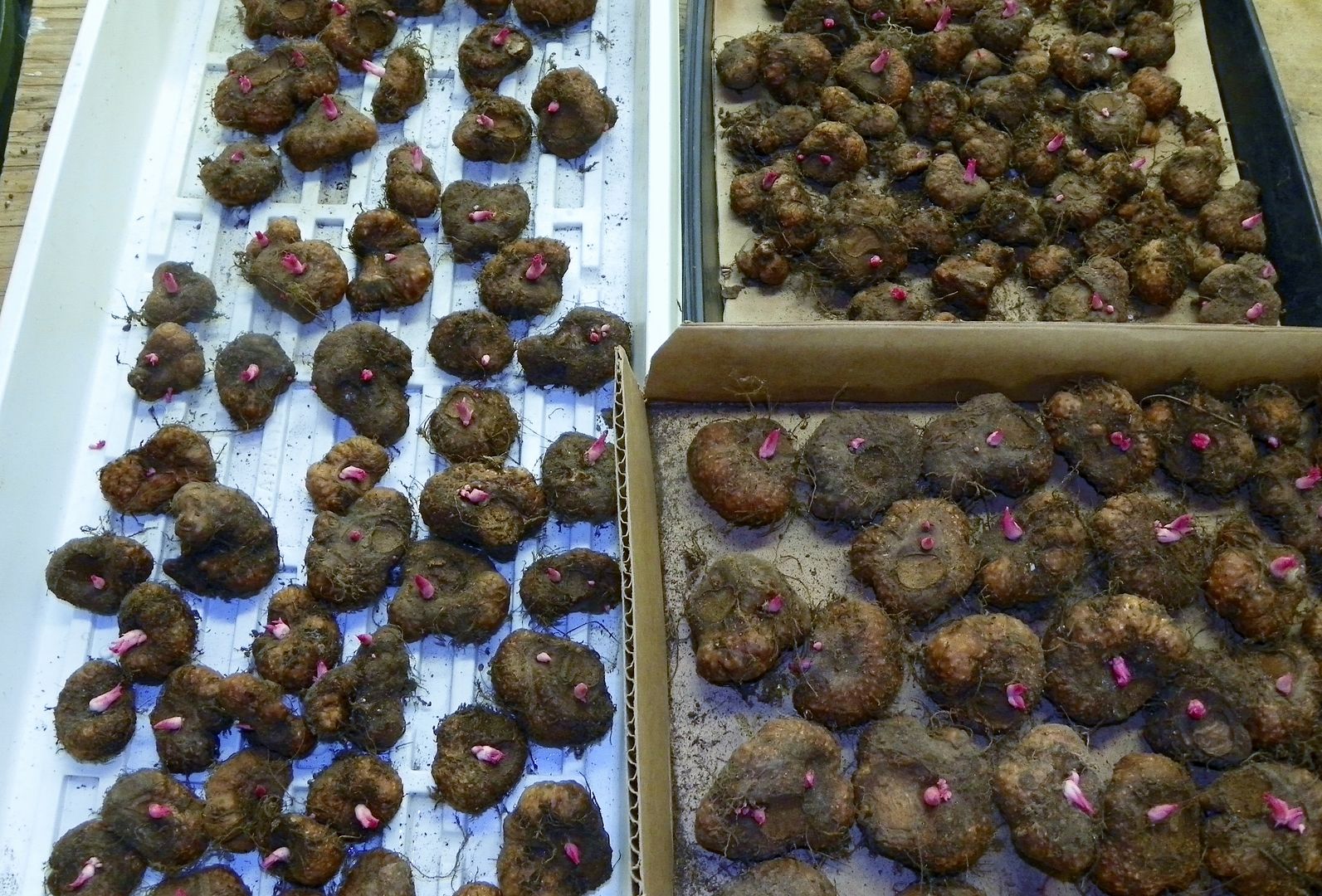
That prompted me to check the stored tubers from last year which were in the cold room in a box. All were showing a small sprout, so they will need to be potted up in a few days.
I usually put the larger tubers in 3" pots, the medium ones in a propagating tray and the tiny ones in 4-cell packs. They get planted with the sprout just showing, but with room for them to have a greater amount of mix added to increase their planting depth. They are put about 5-6 " deep when planted outside.
We try get some sold at our annual Plant Sale, many are planted , and some are just given to friends or neighbors. Being a rather unknown plant, it takes some degree of public relations.
A bit of an update from late April. The little plants have grown beautifully.
Even the two packs with so-called scraps are full of growth.
If anything, we may have too many of these lovely plants. I have kept a count (more or less) and there are from the old tubers thirty six 3" pots, two trays with 24 per tray and sixteen 4-cell packs (56). Add in the ~64 little guys and it gives a large number.
I have been trying to find out if there are other sources for B. grandis here in Canada, but haven't found any. Several places in the United States list them and there are one or two seed sources. .jpg)
We go through each winter with the countdown to spring being a frequent musing.
The last few days saw lots of snow disappear and made the possibility of a reasonably easy walk possible.
This seemed to be the day for other spring pursuits, as I finally started some seeds. We were given some Blue Poppies and Delphiniums last week at the ARHS meeting, so felt compelled to start them. There were also a few items from the ARHS Seed Exchange list I wanted to try. The old Planting Calendar got updated and ready for 2013 entries. This is a snippet of the page. This planting calendar has been the mainstay of my record keeping for many years. Each year I add a new page for the current entries. We have a similar file that is used for Rhododendron and Azalea plantings.
The day had some nice springy items in store, even though we know it will likely stay cold and perhaps snow again. The snowdrops waste no time popping up.
A similar phenomenon was happening in a spot in the Beech bed. Crocus shoots emerging even as snow lies adjacent.
The dogs were very keen on the walk, even if they had to mush through quite a bit of snow. The rhododendrons way back in the hollow were still pretty surrounded.
Grace made a lot of turns and needed a small break.
The purpose of the walk down those rather "slippery slopes" was to see if the witch hazel was in bloom. We were not disappointed. Loads of bloom and a lovely fragrance , which seems quite shocking this time of year.
The little blooms were beautiful against the bright sky.
Bill had a walk also and announced that it appeared there was not much apparent damage to small plants out back, and that the Tree Peonies looked very happy.
This pic is of an actual bud on our "Blue Heaven" rhodies. This will be the first year they bloom at the ripe old age of 12 years.
Other than knowing we will likely have a period of muddiness here and there, it is nice to see these definite signs of spring.
November is not renowned as the favorite month of the year, but this year we are having quite an enjoyable month so far.
It seems we have the usual annual chores that need to be done.
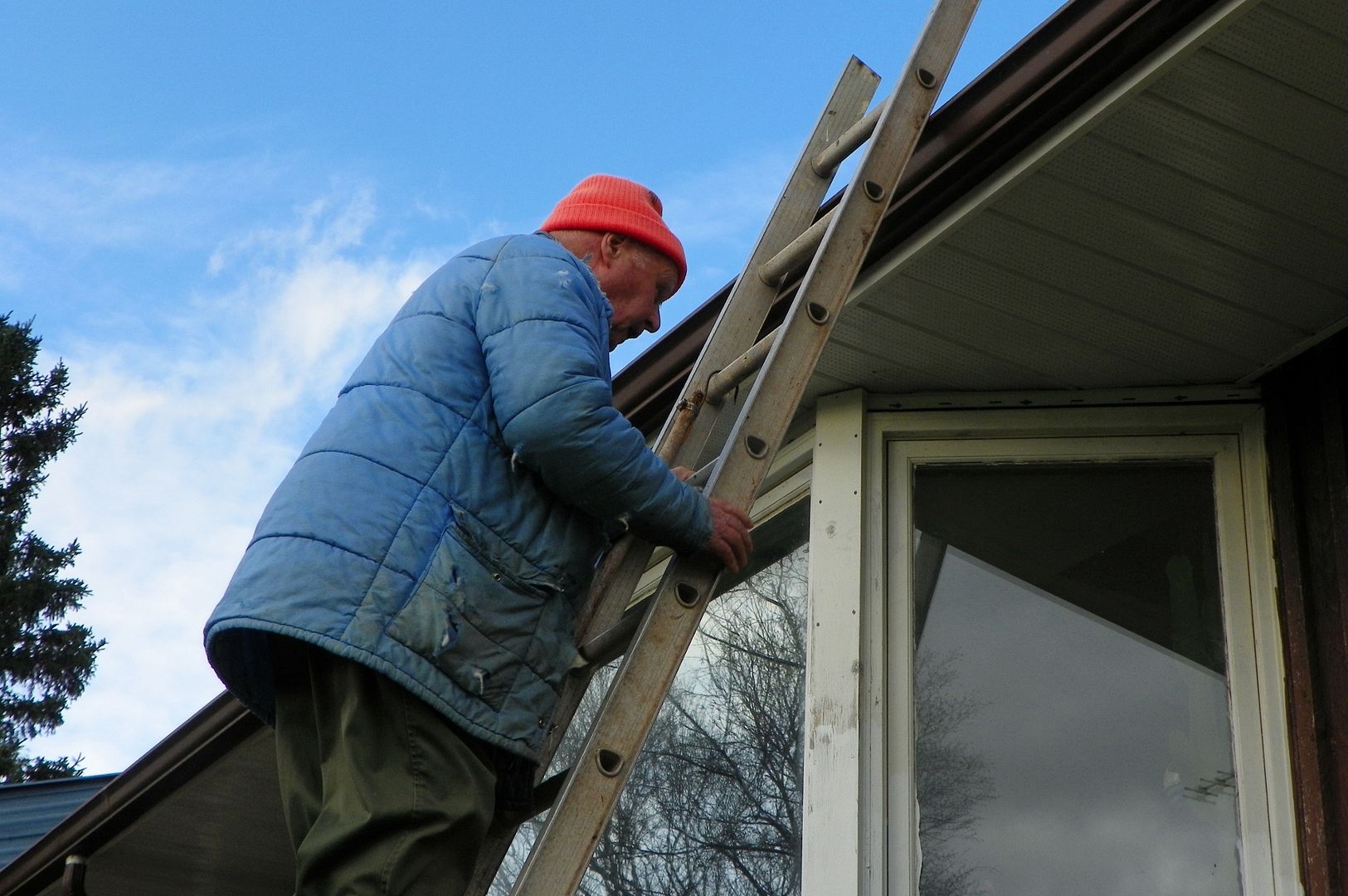
Bill embarked on a gutter clean out a few days ago. The biggest virtue being that it was a nice warm day (Bill will wear his toque regardless!).
The potato pit has had its insulating blanket of leaves added and covered.
This group of baby rhododendrons and azaleas are settled in for the winter. They are not in the usual nursery bed arrangement, since they were very small in early summer. Hopefully they will survive the winter this way. We may put some evergreen boughs over the area to give a little more protection.
After two lovely summery days, we are back to cooler, wetter conditions.
Before that we were the proud recipients of two truckloads of old horse manure. They were added to the manure area.
Now if time and energy would cooperate, we might get some distributed before winter descends.
Each walk around the garden seems to yield some little surprises. This rhododendron seems anxious to bloom . It would normally bloom towards the end of May.
We have been trying to conjure a name for this rhodie, which we had propagated a few years ago. It has rather interesting "peppermint " stripes when flowering, plus doubling of the calyx.
Most of the leaves are down , but the red oaks and several shrubs still are in the process of changing color before leaf drop.
This little Rhododendron dauricum has lovely foliage with different coloration at different times of the year. This species is considered semi-deciduous and will retain part of its leaves and lose others.
Some of the deciduous azaleas have lost their leaves, but others are still vibrant.
This is a nice time to admire the flower buds which will hopefully add to next spring's show.
Some of the Magnolias have pretty buds as well. This is from 'Butterflies', a nice yellow magnolia.
Others don't seem to set their flower buds out in prominence.
We were amazed that these seedlings of Magnolia macrophylla are still very green.
There are always a few little blooms here and there. Some areas of the Vinca minor have a few flowers.
We always admire the Pieris in bud. 'Dorothy Wycoff' is getting fairly well established and is very attractive in the fall. Pinker buds are logical, since she blooms quite pink.
She is much pinker in bud than the "regular" Pieris.
The theme of browns and green is offset by so many things, but is attractive nevertheless. This is Heuchera 'Lime Ricky' nestled among fallen leaves.
The permanent green provided by the rhododendrons is really appreciated this fall into winter time. The good foliage plants will look good most of the year. Some of the heavily "tomented" rhodies are starting to have that surface tomentum worn away as the seasons progress.
The rest of the month will have some birthday celebrations(Ava's and mine) plus the annual Jingle Bell Frolic sponsored by St. Martha's Hospital Auxillary. That event is on November 30th at the Marie Clare at the hospital. I am in charge of the "Fudge" table, so hope there will be another good year of volunteerism. Lots of calls to make this week regarding donations of baking and fudge.
Winter tires are getting installed today, so perhaps that will ward off winter for awhile longer!
Here is a slideshow of these and other images from our mid-November garden.
We have been blessed with two days of wonderfully warm weather for mid November. This seemed like the best opportunity to stow all the miscellaneous potted plants in our dry storage ditch. It is one of the last fall jobs that needs to be done. It is not an especially photogenic story, but such is life! Our soil lends itself to creating such an area, since it is sandy and nowhere will get soggy. We sometimes have to worry that it is a bit too dry here, since the big spruce tree shades and shelters part from normal rain.
This area seems to be populated with plants year round, which doesn't speak well of our decision making abilities. We cleared all the existing plants out and cleaned the extra dirt/compost mixture from the bottom and sides.
A few areas were made a little deeper with the result that we removeded about six wheelbarrow loads from the ditch.
Bill dug a bit more from the end closest to the driveway.
These got piled nearby to be used to fill some material in around the plants after they were repacked. I used this sandy material mixed with old horse manure to make a reasonably light filler to add to the spaces around the pots.
The ditch is almost 3 feet deep in spots and about 2+ Ft. in others. Some of the smaller plants don't need quite the depth. I somehow managed not to fall in during the time spent cleaning out and refilling!
There is quite a variety of plant material stowed in here. Some plants are quite ragged looking, but may get a chance to rebound next season. Several rhodies seem to end up here for years and bloom in spite of us.
We have a Magnolia tripetala that was destined to be planted this last season, but that didn't happen, so back it goes. Same story for our English Oak.
We used Bill's wagon to fetch the various plants.
Many were leftovers from our spring plant sale plus some miscellaneous rhododendrons that were dug in June. Others are small plants that were discovered as layers and need a year or two to get bigger. There are several very pretty little Pieris in this category, plus some azaleas from Spicy Lights and Homebush.
Every thing is back in and just needed watering and material added to fill in spaces.
Here is a little slideshow with some additional images from this adventure.
It is now about mid-October and we have had very little cool weather to let us know winter is coming. Even the development of fall color seems a bit slow. The days are definitely getting shorter. Perhaps hibernation isn't far off.
Most of our veggies are harvested. We had quite a nice group of squash, both Buttercup and Butternut. They are currently the favoured vegetable. We prefer the Buttercup as a usual veggie and appreciate the Butternut for roasting and for making soup. A blend makes for great "pumpkin" muffins or other baking.
The potatoes came through in good health, unlike last year's dismal blight event. The Pink Fir Apple will give us enough for a couple of meals plus some for replanting.
The tomatoes were in moderate supply(by design) and have all been used except for a few Sweet Baby Girl cherry type.
For the first time in my life, I made Salsa. I "hybridized" a couple of recipes and came up with quite a satisfactory product. There were two batches, the second had slightly better texture than the first. I uploaded the recipe to share.
The Begonia bed at the front of the house has been emptied of both regular tuberous Begonias and the B. grandis.
The B. grandis have made a lot of little bulbils this year. This might be due to the tremendous amounts of moisture in the last month or so. I "harvested" a few and will allow them to eventually make new little plants indoors.
There are still quite a few in the garden, but there is no great rush to dig them. They haven't had a hint of frost and are still colorful.
Bill did the hard work of digging up the septic tank so it could be pumped out.
That event has transpired and the hole is pretty much filled in.
After the wet days in the middle of this week, we are destined to get Garlic planted. I separated the heads into the cloves, ready for planting. There are 3 types of hardneck plus a couple of new additions should arrive soon from Botanus.
Speaking of Botanus....I ordered bulbs from them for the first time ever. We have been watching the progress of the parcel via Canada Post's tracking system.
Hopefully it doesn't take eight days to get from Montreal to Antigonish.
GOOD NEWS! The bulb package arrive Oct18th. Now to get them planted. Labels have been prepared, so a bulb planting day is definitely in the works.
I vowed not to plant bulbs this fall, but that hasn't been too successful. I succumbed to some at Pleasant Valley Nurseries and then did the Botanus thing. Hopefully the weather stays nice for bulb planting.
Bulbs seemed to be in the forefront the last while. We gave a presentation to the Garden Club on Spring Flowering Bulbs which seemed to be well-received. It was rather a combination of information and "eye candy".
Looking forward to spring seems to be a thing all gardeners do.
Spring comes to mind every time we look at the rhododendrons. They seem to have phenomenal bud set this year. This is Scintillation, wet and shiny and well budded.
The annual "bring in the plants" event has happened, so the sunporch is even more cluttered than usual. The big Bay tree monopolizes the space. Here is a bit of a slide show dealing with Bay tree and leaves.
There are some hot pepper plants in as well. They will finish ripening and get picked to dry. The Ring of Fire peppers are always very dependable. We grew a cute ornamental pepper this year called Calico. It has been lovely as a containers plant. The little purple peppers are fairly hot.
Hopefully I may be able to save some of their seeds to plant again next year. If not, there is always Lindenberg Seeds!
Fall is therefore proceeding as usual. Bill has started a bit of wine making. There are, of course, still miscellaneous plants to properly stow somewhere for the winter.
_zps74861206.jpg)

.jpg)
 If anything, we may have too many of these lovely plants. I have kept a count (more or less) and there are from the old tubers thirty six 3" pots, two trays with 24 per tray and sixteen 4-cell packs (56). Add in the ~64 little guys and it gives a large number.
.jpg)

.jpg)


.jpg)